
Toyota Highlander vs 4Runner

When you need an active SUV to take you on your weekly getaways near Orleans, Eastham, and Harwich, MA, there are plenty of options for you in the Toyota lineup. For example, you may be interested in the 2021 Toyota Highlander or 4Runner.
Both are excellent SUVs, but which one is exactly what you’re looking for? That’s what the team at Ira Toyota of Orleans is here to help you figure out. Read through our comparison and give us a call to chat with us directly!
Highlander vs 4Runner: Performance Specs
Whether your vacations take you off-road or stay on the paved path, both the Toyota Highlander and 4Runner are well-equipped for anything that may come your way. For example, they both come standard with a V6 engine. Let’s see how much power both rides can generate:
|
2021 Toyota Highlander |
2021 Toyota 4Runner |
|
| Standard V6 engine |
3.5L V6 |
4.0L V6 |
| Horsepower |
295 horsepower |
270 horsepower |
| Torque |
263 lb-ft |
278 lb-ft |
You may have noticed that the Highlander produces more horsepower, but the 4Runner delivers more torque. Despite their differences in engine specs, they can both tow up to 5,000 pounds when properly equipped.
Highlander vs 4Runner: Dimensions
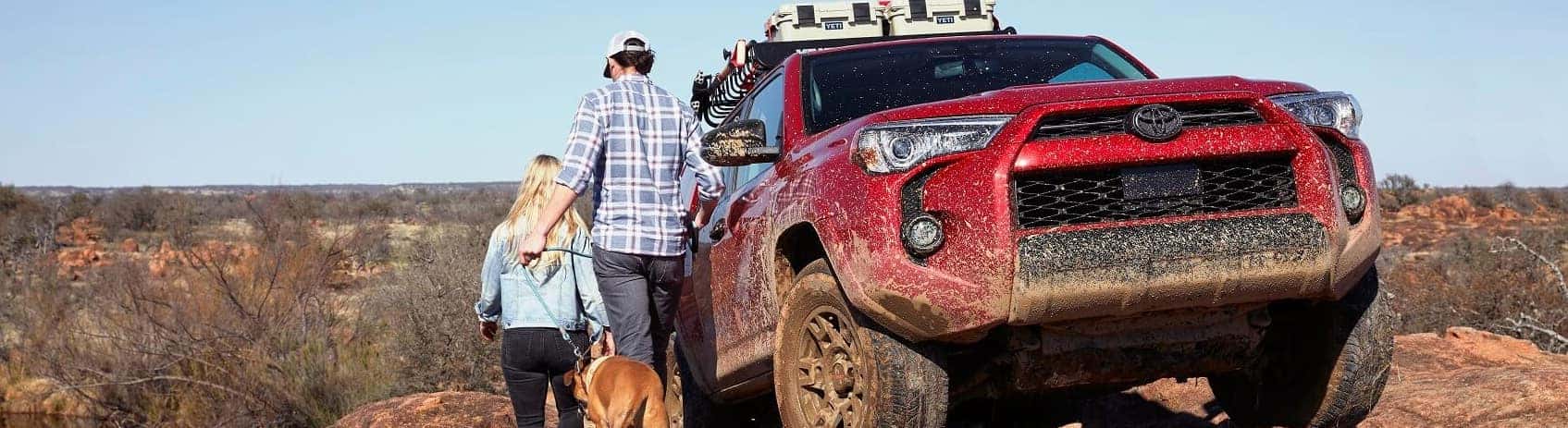 Now that we’ve looked at what the Toyota Highlander and 4Runner offer under the hood, let’s climb inside the cabin and have a look around. Right away, you’ll notice a roomy cabin with up to three rows of seats.
While the Highlander comes standard with three rows and enough room for up to eight passengers, the 4Runner gives you a choice between a 2-row cabin that can seat up to five passengers or a 3-row cabin that can seat up to seven passengers. Here’s how their other dimensions measure up in their 3-row configurations:
|
2021 Toyota Highlander |
2021 Toyota 4Runner |
|
| Headroom (first/second/third) |
41.2 in./39.4 in./36.1 in. |
39.3 in./38.6 in./34.3 in. |
| Legroom (first/second/third) |
42 in./41 in./27.7 in. |
41.7 in./32.9 in./29.3 in. |
| Total cargo volume |
84.3 cubic feet |
89.7 cubic feet |
| Cargo volume (behind third row) |
16 cubic feet |
9 cubic feet |
As you can see, these two SUVs are relatively evenly matched as far as headroom and legroom for all passengers. The 4Runner offers more cargo volume with the second- and third-row seats folded down, which is ideal if you have a lot of furniture to move or want to carry mountain bikes out to the trail.
However, the Highlander has more cargo space behind the third-row seats, which may give you more room for sporting equipment when you’re carpooling to baseball practice.
Toyota Highlander vs 4Runner: Technology & Safety
 As Toyota SUVs, you can expect to find a plethora of driver-assistive systems as a standard feature whether you’re driving the Highlander or 4Runner.
The Highlander comes standard with Toyota Safety Sense™ 2.5+, and the 4Runner comes standard with Toyota Safety Sense™ P. Both are suites of predictive features that are designed to help improve your awareness of your surroundings. They include systems like:
- Pre-Collision System with Pedestrian Detection
- Automatic High Beams
These suites also include a smart cruise control system, as well as a feature that sends a warning when you depart from your intended lane of travel.
Inside the cabin, both SUVs include a standard 8-inch touchscreen that keeps you connected to your favorite media apps on the go through standard Apple CarPlay®, Android Auto™, and Bluetooth® wireless connectivity.
Will You Drive the Toyota Highlander or 4Runner?
Now that you know how the Toyota Highlander and 4Runner compare, which will you drive near Eastham, Harwich, and Orleans, MA? The team at Ira Toyota of Orleans can help you decide, so contact us to test drive a Toyota SUV today!
